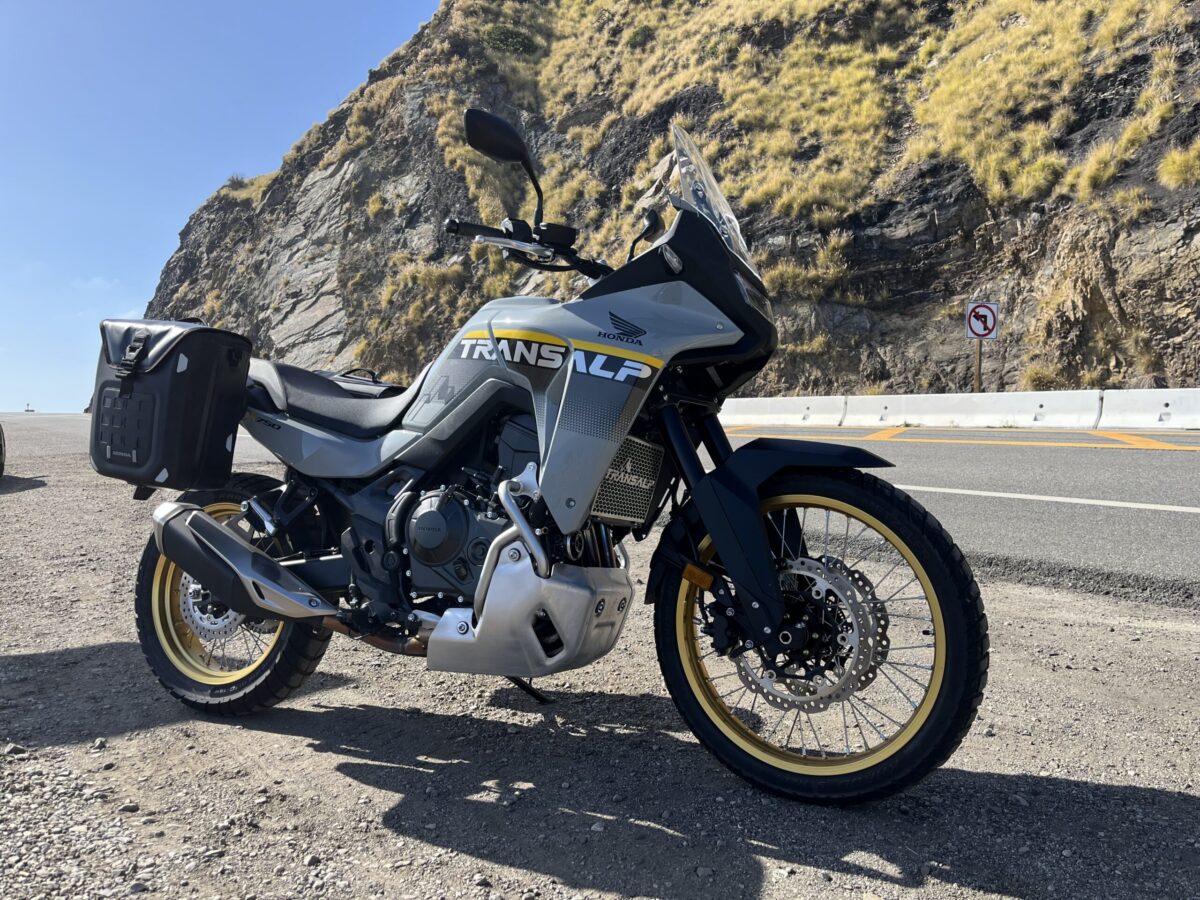

The refreshed Honda Transalp 750 was first sold in Europe in 2023 and in the U.S. a year later to go up against fierce competition in the 700-800cc adventure bike segment from the Yamaha, Triumph, BMW, KTM, and China’s CFMoto. As such, it had to be as close to perfect in terms of performance AND value. With the 2025 edition of the Transalp, Honda pretty much nailed it.
The Gravel Bike of Motorcycles
For more than a decade, gravel bicycles have driven a resurgence in cycling interest among riders who are not interested in sharing tarmac with ever-bigger cars and trucks or keen on launching off house-sized jumps on a mountain bike. The gravel bike fits somewhere in between, and that’s where adventure bikes like the Transalp fit, also. It’s not a trail bike. It’s not a track bike. It’s a touring bike suited to “roads,” which can be defined as anything between a U.S. Forest Service double-track to an 80mph Interstate in Montana. So Honda offers “Gravel,” not “Dirt” in its rider modes (Rain, Sport, Standard, and two custom settings are also available).
The bike’s narrow 21-inch front wheel connects to Showa shocks with 7.9 inches of travel, while the rear 18-inch wheel is mounted to a swingarm and a Showa shock with 7.5 inches of travel. For an adventure bike, the suspension feels crispier than expected. Hard braking on tight, twisties didn’t cause the bike to dive forward. The same goes for hard accelerations out of those turns. The bike shoots forward in a linear fashion, instead of compressing its mass to the rear.
Transalp Touring

The 755cc parallel twin pumps out 92-hp, which was plenty to lope along at 4,000-4,500 RPMs, holding 75mph over the mountainous Grapevine of I-5 between Southern California’s San Fernando Valley and the Central Valley. Running above 4,200 RPM seemed to put the engine into its happy zone, no matter the gear, with snappy accelerations the norm. The 4.4-gallon fuel tank and 55-60 highway MPG give the bike a comfortable range of 210 miles or so, which is plenty long to go between fuel stops.
The bike’s standard seat height fit my 6’2” frame darn near perfectly. I could plant my feet comfortably flat on the ground, and the foot pegs’ placement produced a comfortable, not excessive, bend in my knees. The result was an upright riding position that made all-day rides a piece of cake. Even the rather thinly padded stock seat didn’t bother me. I liked its relatively narrow profile; it helped make the Transalp super easy to maneuver at slow speeds.
My test bike from Honda came outfitted with Honda’s Top Bags, waterproof soft panniers that can adjust in size and are sized perfectly for a long weekend of riding, and are easy to detach and carry into a motel or camp. Unlike side-access hard cases that can spill their contents, access through the top of the soft bags with roll-top closures made it easy to store and grab glasses, hats, and other coffee break items. Honda did a clever and elegant job designing these storage units. So well that I would consider them over hard panniers any day.
What’s New for 2026?
The biggest difference between the 2025 model tested here and the 2026 models is that Honda made its E-Clutch standard on the Transalp (and also added $1,000 to the price). The E-Clutch allows riders to simply shift the foot lever up or down without squeezing the hand clutch. From a stop, you twist the throttle and go. Same when executing tight, low-speed maneuvers off-road. When shifting down, the E-Clutch automatically rev matches the downshift smoothly. And if you do want to work the hand clutch, Honda lets you turn off the E-Clutch and enjoy a more visceral shifting experience.
I was initially disappointed that I wouldn’t get to experience the E-Clutch, but the old-school operation on the 2025 was so smooth and effortless that I didn’t care. The Transalp is already so confidence-inspiring to ride across so many different types of roads and terrain. I’d rather save the $1,000 and use it to fund more rides.
The Numbers
- Starting MSRP: $10,599 (destination included)
- Price as Tested: $12,254 (destination included)
- Optional Equipment. Heated grips ($156), soft bags with rack mounts ($739), skid plate with engine cage ($475), radiator grill ($106).
The Test Route
I tested the Transalp over a 550-mile, four-day trip from Los Angeles to the Carrizo Plain National Monument and over to San Luis Obispo on California Highway 58 (A bucket list road if there ever was one). From San Luis Obispo, I followed Highway 1 to Lompoc, then headed to Santa Barbara via San Marcos Pass, finishing on the Pacific Coast Highway into Los Angeles.